
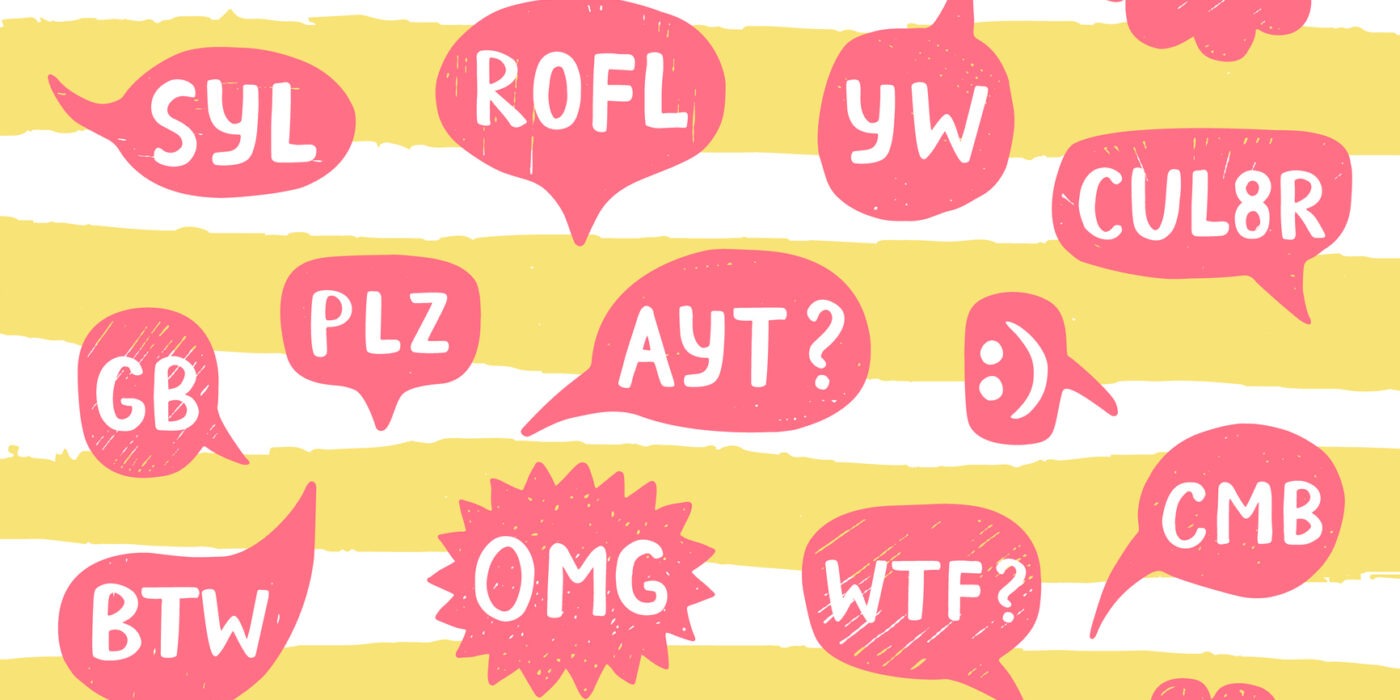
Once upon a time, I was in a meeting. (In fact, I have been in meetings hundreds of times… but I’m trying to tell a story here, so let’s go with “once”!) We were looking at some rather complicated statistics, but everything was clearly presented and easy to understand. Lots of nice charts and easy-to-follow bullet points. I was taking notes, feeling confident that I was following what was being said and sure that I could participate in any discussion that might follow.
But then confusion ensued. The presenter decided to say this: "So, to improve our SEO, we really need some solid CTAs. Otherwise, our BR will stay high. What we need is good CRO. So, if we could all go back and add some really great EOP CTAs today, that would be great."
I looked at my fellow colleagues. Everyone nodded.
"Why?" I thought to myself. "Why are they nodding when what's been said is clearly some kind of strange language? Do they understand it? Because I certainly don't. But I don't want to look stupid. The best thing is to stay quiet and nod as if I do understand everything. No one will notice."
And everyone lived in complete confusion ever since. The end.
(Not really. Let's continue…)
Acronyms and abbreviations: why do we use them? Because?!
I can't fully express how much I hate abbreviations. When I'm reading a sentence and suddenly one appears, without warning (and without explanation), I'll be honest, I just want to throw my computer out the window.
But, in reality—and because then I'd have to have a very complicated and awkward discussion with my boss—I basically ignore the phrase. I gloss over it and make up a phrase that I think the letters probably stand for. CTA? "Smart stuff, okay"?
Abbreviations are like hiccups in an otherwise enjoyable article. Really annoying hiccups that I wish would just disappear. And while most people use abbreviations to communicate things quickly, I'd argue that what they're really doing is distorting the meaning and alienating others. In fact, they often make me feel rather stupid and excluded from the "we're not that smart" abbreviation club.
The history of abbreviations
While writing this blog, I thought I would try to understand what exactly is at the heart of our apparent dependence on commercial acronyms and abbreviations . Interestingly, I discovered that they actually date back to ancient Rome. But abbreviations really caught on when publishers used them to try to save valuable space on printed pages.
Spies often use acronyms or abbreviated words to encode their messages. (Trying to understand them is often like trying to decode some secret language!)
And abbreviations have become particularly popular for shortening long technical or scientific terms. In fact, an investigation published by elifesciences found that more than one million acronyms and abbreviations have been introduced since 1950. Interestingly, many of them are exactly the same, but have different meanings. The abbreviation UA, for example, has 18 different meanings in medicine alone.
The research also revealed that our increasing use of acronyms and abbreviations, particularly in scientific articles, has led to a “knowledge-ignorance paradox.” Essentially, the number of scientific articles published has increased, but the knowledge taught has been reduced. Because scientific articles are often written in an overly complex way that leaves the reader scratching their head.
And while it's true that some abbreviations are so well-known that they could be considered words in themselves (DNA, for example, or CIA, FBI, LOL), these are rare. And new abbreviations (many of which I suspect people just made up because they can't be bothered to write a complete sentence or because they're trying to sound smart) are all too common.
Acronyms and abbreviations vs. Accessibility _
Accessibility is now a buzzword for many organizations and content creators. And acronyms and abbreviations, although they often have their uses, are not particularly accessible. Screen readers can't read them (or read them incorrectly). And, for people who have neurodivergences that make reading difficult, they can be at best annoying and at worst inscrutable.
I recently had the wonderful privilege of leading a panel on neurodiversity at work to learn more about neurodivergence and the challenges it faces. What Neurodivergent People Experience in the Workplace . Among the panel are people with a variety of neurodivergent conditions, including autism, dyslexia, and attention deficit hyperactivity disorder (or ADHD; sorry for the abbreviation).
One comment that came from everyone on the panel – and I mean each and every one – was this: STOP USING ACRONYMS AND ABBREVIATIONS!
So I asked the panel to explain further. Why are abbreviations so annoying for neurodivergent people? As expected, they had a lot to say…
Melanie Bell, Content Editor and Writer at Mind Tools
"Acronyms and abbreviations are part of office jargon that many organizations use more than necessary! It can be difficult to decipher or remember what acronyms mean. I believe most employees would benefit if they were used much less and were clearly explained if their use was absolutely necessary."
“I used to work for a think tank that used a lot of acronyms in articles. They had some that were common knowledge in the field, so they weren’t explained in detail. But most of them were explained in abbreviation code and also in detail when we first used them. I think abbreviations are sometimes useful for conveying complex information, especially when we use the same long abbreviations repeatedly. But we need to check for understanding. It’s part of being clear and friendly. It hardly takes any extra time to say what an abbreviation means when you use it in a meeting or talk. Communication should be about making sure people understand what we’re saying. Don’t make it the listener’s responsibility to say, ‘I don’t know.’ – please explain.”
Jason Richardson, Talent Development Leader in Emerald Group
"I find them overwhelming and overused. Most of the time, they don't contribute to the conversation, and there are so many with the same letters... it's just unnecessary! I said the word total once so everyone knows the context, then Crack in."
"I've found that I need to ignore them if I understand the context. Or if I'm lost, I ask what it means, which is a waste of time, which is ironic since they were meant to save time."
"Having a key acronym or abbreviation wouldn't work for me either, especially in the publishing industry, since there are so many. For example, in my business, everything starts with an E, as all the products start with an E. They really need to get rid of them. Or at least have a one-month amnesty where we all see what happens when we don't use them. If they get lost, bring them back and I'll hug them as much as I can."
Gabi Hart, Product Manager at Emerald Group
"I have dyslexia and I find that acronyms and abbreviations are always a hurdle I have to overcome and need time to decode. Even if I've used them before, sometimes it can be difficult to remember the actual meaning behind them instead of just seeing them as a string of letters."
“Using acronyms or abbreviations without a ‘key’ can make me feel like I don’t understand something that someone else considers so obvious it doesn’t need explaining, which is discouraging. It assumes everyone knows what you’re talking about,” which may be dividing the rest of the staff, especially neurodivergent and newer staff.
"The first time an acronym or abbreviation is used in a piece of text, it's helpful to make sure the full phrase is used. That way I can check what it means within the text, without having to Google it or dig up an internal document to explain it."
Emily Vaz, Business Partner at Mind Tools
"I have a mixed relationship with acronyms and abbreviations: sometimes they're great, and other times they're really challenging. I can often mistake one I don't know for a real word, which has occasionally made me look a bit silly. I've found that I've gotten quite used to not being familiar with a word, or a word that seems strange, so sometimes an abbreviation doesn't stand out obviously as an abbreviation."
"I also struggle with abbreviations where the letters don't reflect the full name. For example, LWOP (unpaid leave). The extra 'o' throws me off. And in ETA (estimated time of arrival), not having the 'o' also confuses me. That said, I prefer to use abbreviations I use regularly and am very familiar with, like FTE (full-time equivalent). I use it a lot, and I would struggle to type 'equivalent,' so it definitely helps."
"They can be tricky, especially if it's a particularly specific abbreviation that you can't easily Google. I'm generally never afraid to ask, but I am concerned about asking what a word means instead of a..." abbreviation . mentioned, sometimes I have a hard time knowing if an abbreviation is a real word or not. If I don't feel comfortable asking, I tend to ignore it or just try to guess what it might mean. I appreciate that people put what it means in parentheses at least once, so that if it's referenced again, I can go back and check what it means.
"It's great to have a key for acronyms or abbreviations, or to have acronyms in a separate color or underlined, so you can identify that it's not a word."
Jaye O'Farrell-Stevens, Chief Customer Officer at Mind Tools
"I hate acronyms and abbreviations with a passion, and I hate them despite my dyslexia, although my dyslexia certainly makes things worse. When I started my engineering studies, if we used an abbreviation, we'd get 'hit on the head' and we were taught that they're the preserve of people who want to appear intelligent without actually being so, they're exclusionary and presumptuous, and by forcing you to say, 'Sorry, what does that mean?' you know, it makes you feel stupid and the other person powerful."
"When I first joined Mind Tools, I think every other expression was an abbreviation, and I felt completely lost, but I didn't want to make a fool of myself by asking what it meant. Because presumably, if everyone knows, surely I should. I felt so stupid and a complete imposter. I actually came to dread one-on-one meetings when I couldn't discreetly look up what SEO meant."
"I think using acronyms and abbreviations is a way of showing you're 'in the club,' that you're part of the team, that you really get it. It's a way for people to express themselves and assert their knowledge or their position on a team. I think they're really exclusionary, and I try to avoid using them as much as possible."
How to use acronyms and abbreviations the right way
As much as I'd like to say, "Acronyms: please, bogoff forever" (and I don't mean buy one, get one free), unfortunately, they're here to stay, at least in some cases. I mean, I'm hardly going to say full deoxyribonucleic acid every time I talk about DNA (not that I talk about DNA that much, but you get the idea). Nevertheless, there are some simple things we can all do to use acronyms and abbreviations appropriately and in a way that is neither exclusive nor presumptive:
- Know your audience . Don't make assumptions about what acronyms and abbreviations people know and don't know, especially if you're giving a presentation or are in a team meeting.
- Spell it. It is good manners to say or spell the phrase in its entirety, at least in the first instance. That way, people can refer to it while reading the text.
- Avoid making up acronyms or abbreviations. There are already too many, so avoid inventing more! It's okay to use common acronyms or abbreviations that are widely used in society or in your particular industry. But even then, try to limit yourself to three or fewer per document.
- Use periods or spaces between letters if you create content for the web. This is best practice for accessibility because screen readers will read the letters individually, rather than as a single word. It also tells readers that what you are using is an acronym or abbreviation, not a word.
- Provide an acronym and abbreviation "key" or configure an acronym expander. If you use acronyms and abbreviations regularly, consider providing a glossary that your audience can refer to, if necessary. If you have free time, you can even set up your own acronym expander using autocorrect .
- Underline acronyms and abbreviations in the text so people can identify them. This can help people identify which words are acronyms or abbreviations and which are not, since the distinction is not always clear. This can be especially helpful for people who have dyslexia and have difficulty reading some words.